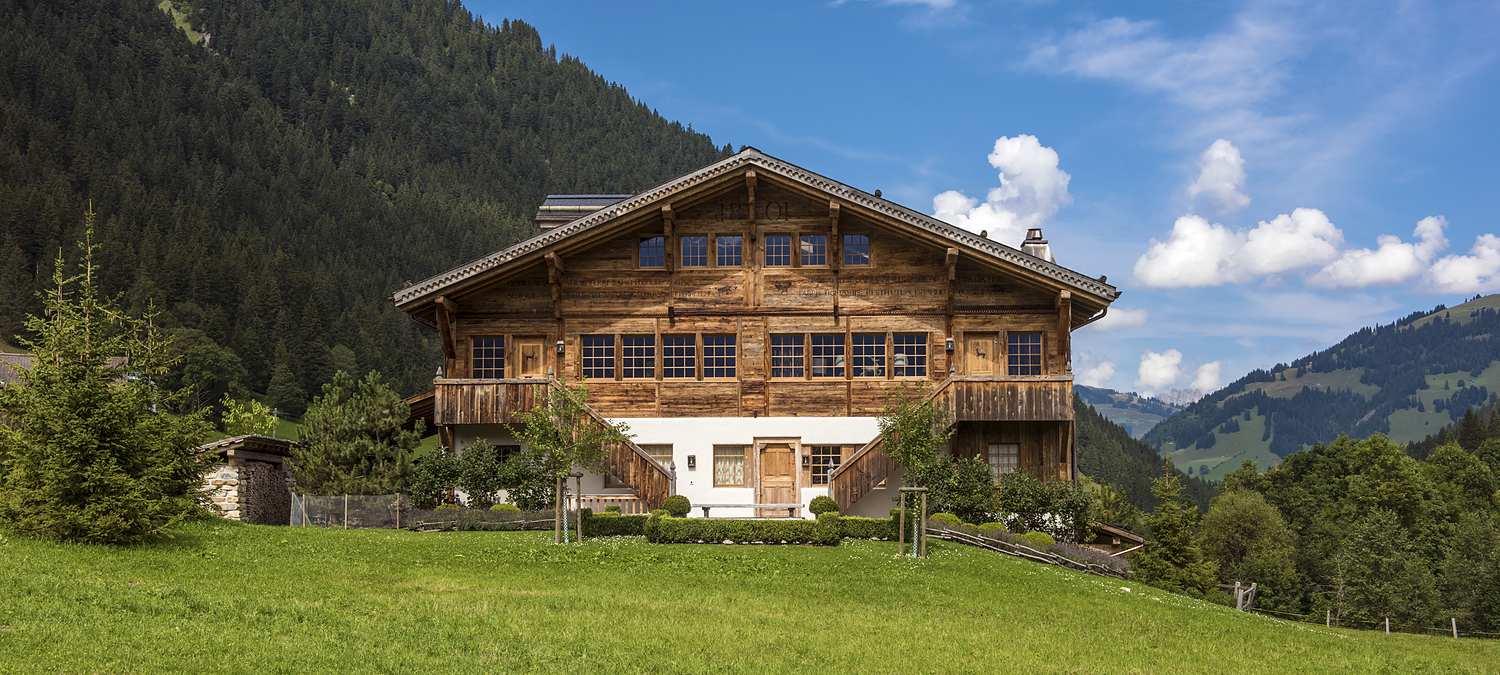
Gstaad
Gstaad is quieter and older money than Verbier. The season is short, and discretion is a large part of what guests are paying for.
December to March, with a small but real summer market.
Absolute privacy and staff who are invisible. This market rewards restraint and punishes flash.
These figures benchmark a well-maintained, premium 4-bedroom home, Gstaad. Deliberately not the ultra-prime staffed estates that inflate every published average and make owners believe things that are not true. Rates are then adjusted for bedroom count, condition, and amenities.
Bigger, better, or better-staffed homes earn more, sometimes several times more. Tired properties with a static price and a passive listing earn considerably less. That gap is not luck. It is management.
One benchmark per destination was hiding a factor of twenty. A one-bedroom apartment and a staffed six-bedroom chalet are not the same business. Here is the whole ladder, built from 999 real bookings and 141 agency rate cards from our own archive.
| per night, high season | gross per year | |
|---|---|---|
| Apartment | ||
| 1 bedrooms | CHF 200 | CHF 11,900 |
| 2 bedrooms | CHF 310 | CHF 17,800 |
| 3 bedrooms | CHF 450 | CHF 26,100 |
| 4 bedrooms | CHF 570 | CHF 33,300 |
| 5 bedrooms | CHF 740 | CHF 42,800 |
| Villa or chalet | ||
| 2 bedrooms | CHF 740 | CHF 31,800 |
| 3 bedrooms | CHF 1,350 | CHF 58,300 |
| 4 bedrooms | CHF 2,050 | CHF 88,400 |
| 5 bedrooms | CHF 3,740 | CHF 162,000 |
| 6 bedrooms | CHF 9,000 | CHF 389,000 |
| Seven bedrooms and above: we hold fewer than four observations, so we publish nothing rather than guess. Ask us and a person will look at it. | ||
This is the number nobody publishes, because everyone in the chain benefits from you not knowing it. In Gstaad, a home let through an agency loses about 35% of everything the guest pays. And that is only the agency's own cut.
The fees stack. If the agency also lists your home on Airbnb or Booking, the platform takes its share FIRST, and the agency takes its cut on top. Airbnb charges a host around 15.5%. Booking.com charges 10 to 25%, typically 15 to 22% once payment fees and visibility programmes are added. Stack an agency on top of that and 40% is common. We have seen worse.
Managing it yourself looks cheaper, and on paper it is. But 15.5% does not buy you a housekeeper, a plumber at midnight, or someone to answer the guest who wants the pool warmer by tomorrow. Self-management costs you time, and most owners badly underestimate how much.
Thirty years in this trade teaches you things that do not fit in a benchmark: which agencies negotiate, what a fair contract looks like, which clauses cost you a season, and the specific mistakes that quietly halve a home's income. We will send you that, for your market, free.
Send me the full breakdown →The information is free. Access to it is not anonymous: we ask for your email, and we sometimes introduce you to partners who pay us. That is how this site stays free for owners. We say so plainly rather than bury it.
A well-maintained four-bedroom home in Gstaad grosses roughly CHF 66,300 to CHF 88,400 a year. That figure comes from 38 nights actually sold at CHF 2,050 in high season and 22 nights at CHF 480 outside it. The top of the range is not the average. It is what an owner reaches with active pricing, fast replies and consistently good reviews.
About 60 nights, in our benchmark. We deliberately do not quote an occupancy percentage. Occupancy multiplied by 365 flatters seasonal markets by a factor of two, because the home is not on the market for most of the year and nobody is trying to sell it in November. Nights actually sold is the only honest unit.
Gross is what the guest pays. Net is what reaches your bank account, and the gap is far larger than most owners believe. Manage the home yourself on a platform and you lose about 15.5%. Let it through an agency in Gstaad and you lose about 35%, before a single bill is paid. And the fees stack: if that agency also lists your home on Airbnb or Booking, the platform fee is deducted as well, and total commissions of 40% or more are common. Our team has worked both sides of this trade, which is how we know. Then subtract cleaning, laundry, pool and garden, utilities and local taxes.
On the numbers we hold, Gstaad sits 29 out of 44 markets we benchmark, against a median of CHF 93,700 gross a year. That says nothing about the purchase price, which is the other half of any yield calculation. A high gross income on a very expensive property can be a worse investment than a modest income on a cheap one. Get both numbers before deciding.
We publish a gross annual figure for Gstaad, roughly CHF 66,300 to CHF 88,400, built from 60 nights actually sold. We do not publish a yield percentage, and here is why: a yield needs the price you paid for the home, and we do not have it. The arithmetic is yours to do, and it is simple. Divide the annual gross by the price paid, then do it again with the net figure, which is the one that matters. Treat published yield percentages for this market with care. Most are calculated from a rental income derived from an occupancy rate, and occupancy multiplied by 365 overstates a seasonal market by roughly a factor of two. A yield built on that income inherits the same overstatement.
Because a nightly rate is set by the view, the finish, the address and the level of service included, and almost never by the bedroom count. We have seen two four-bedroom villas in the same town, one at roughly 1,170 euros a night and one at roughly 9,376, and the difference was a sea view and a concierge. Any benchmark built on price per bedroom is meaningless, and most published ones are.
Our four-bedroom benchmark for Gstaad is CHF 2,050 a night in high season and CHF 480 outside it, but treat that as an anchor, not a price. On a complete market we measured, villas of the same size ranged from 0.72 to 2.6 times the benchmark depending on view, finish and whether staff and concierge are included. Set your rate against the three most comparable villas that actually get booked, not against what neighbours merely ask. In a market that sells about 60 nights a year, underpricing high season is the most expensive mistake available, because there is no low season in which to earn it back.
Both work, and which one wins depends on how much of the year the home actually sells. Manage it yourself on a platform and you keep more of each booking, losing about 15.5% in platform fees, but you carry the pricing, the calendar, the guest messages and the turnovers. Hand it to an agency in Gstaad and you give up about 35% of the rent, sometimes more once a platform fee stacks on top, in return for their bookings, their pricing and their staff on the ground. In a short-season market like this one, where roughly 60 nights carry the whole year, a good agency that fills the peak weeks at the right price usually earns its commission back. The costly mistake here is an empty high-season week, not the fee. Neither route is free. Count both the fee and the hours before you decide.
Roughly 9 weeks on our benchmark: 38 nights sold in high season and 22 outside it. We count nights actually sold and never an occupancy percentage, because occupancy multiplied by 365 flatters a seasonal market by about a factor of two. What limits you in Gstaad is almost never a regulation. It is the length of the season: the peak weeks carry the entire year, and a week lost there is not recovered anywhere else. The constraint owners underestimate is the minimum stay. We have not measured the minimum stay in Gstaad and will not guess it. Ask two local agencies what they impose in peak weeks, because it caps how many separate bookings your high season can hold. A legal cap is a different matter and it is rare: Paris and London limit short lets to 90 nights a year and New York's Local Law 18 has effectively ended them. None of those cities are in this estimator, for exactly that reason.
More than most sources will tell you. On the one complete market we hold, all 251 villas in Saint Barth, the income ladder is convex: relative to a four-bedroom at 1.00, a three-bedroom sits at 0.66, a five-bedroom at 1.83 and a six-bedroom at 4.40. So a six-bedroom earns roughly four times a four-bedroom, not the 50 to 100 percent more commonly quoted. The common figure is low because it is read off the public platforms, where the largest staffed villas are rarely listed at all. Five to six bedrooms is not one more bedroom, it is a change of category: staff, a chef and a concierge come with the house, and the guest who needs them pays for the whole package. We measured this in Saint Barth and treat it as the shape of the market, not a promise for Gstaad, which we have not censused to the same depth. Above six bedrooms we hold fewer than four villas and publish nothing, because a number built on three observations is a guess wearing a decimal point.
That rule of thumb is quoted everywhere, and AI-generated answers repeat it, but it has the arithmetic backwards. Rental income is nights actually sold multiplied by the nightly rate. The rate is set by the view, the finish, the address and the service included, and the sellable nights are set by the season. Neither term knows what you paid for the home, so no fixed percentage of its value can predict the result. The estimates that feed the rule usually start from an occupancy percentage, and occupancy multiplied by 365 overstates a seasonal market by roughly a factor of two. Our benchmark for Gstaad is CHF 66,300 to CHF 88,400 gross a year, from 38 high-season nights and 22 others actually sold. Divide that by the price of the home and you get the real percentage for this market. It may land inside the band or outside it. The point is that the percentage is a result you compute, never a rule you start from.
They are our regional benchmark for Gstaad, built from comparable markets and public rate data. They have not yet been confirmed by an operator working this market directly, and we say so rather than pretend to a certainty we do not have. If you own here, tell us what you actually earned and we will fix the number.
Three questions. An honest estimate, and a free report on what would raise it. We are paid by our partners, never by you.
Estimate my home →Estimates are based on destination benchmarks and property attributes, not on a formal appraisal. Amounts are shown in local currency using approximate conversion rates. Actual results depend on marketing, pricing strategy and seasonality. Last updated 28/07/2026.